
Primary Abstraction
Abstract art reduced to elementary shapes and colours, with no reference to people, places or things.
162 works · 10 related artists
About
Primary abstraction strips a picture or object down to basics: a square, a line, a band of pure colour, a single light. The aim is not to simplify something seen but to present form and colour as subjects in themselves.
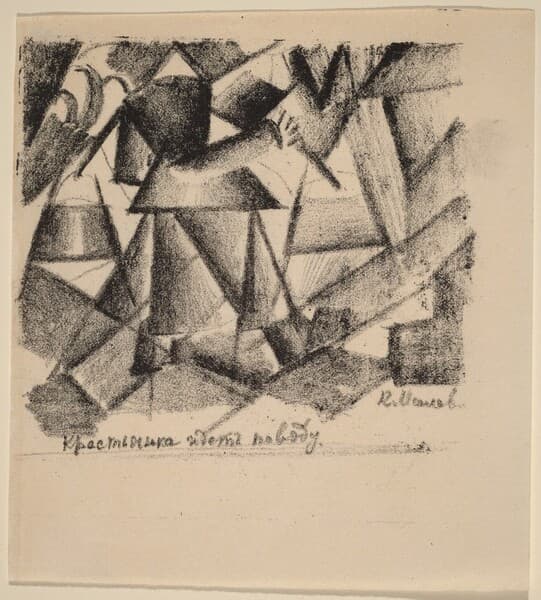
Kazimir Malevich's Black Square, shown in Petrograd in 1915, is a starting point, followed by Lyubov Popova's overlapping planes and Piet Mondrian's red, yellow and blue compositions of the 1920s. After 1945 Barnett Newman divided vast colour fields with narrow vertical 'zips', Ellsworth Kelly painted single-colour shaped panels, and Carmen Herrera reduced compositions to two colours and a crisp edge. Dan Flavin's fluorescent tubes of the 1960s made standard light fittings do the same work. Lee Ufan, working between Japan and Korea, repeated single graded brushstrokes in the 1970s, a related reduction with different roots. Look for few elements, flat colour and no hint of illusion.
Related artists
More in Visual Qualities
Primary Colors
Psychedelic
Radiating Lines
Raw versus Finished

Rough
Scattered Composition
Single Object
Slender
Smooth Surface
Sparse
Stained Glass Effect
%2520-%25201918-w-3.jpg%3Fwidth%3D960&w=3840&q=75)
Striped
Symmetrical
Tangled Forms
Viscous Forms
Wrapped
Abstract Illusionism
Allover Composition
Angular
Asymmetrical
Balance
Biomorphic
.png%3Fwidth%3D960&w=3840&q=75)